
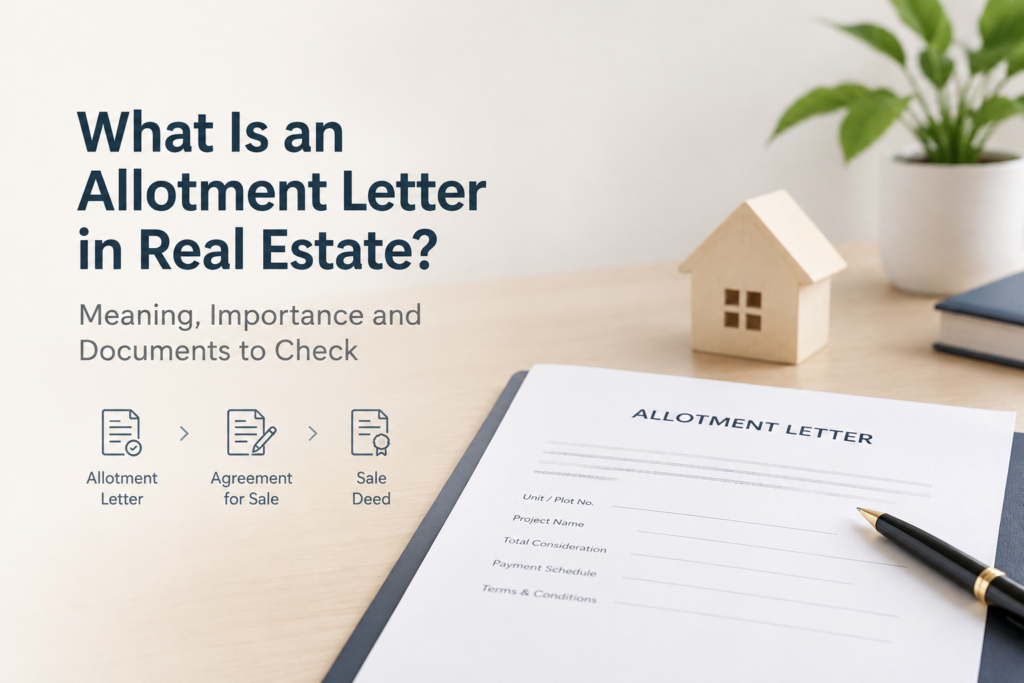
Buying a property involves several documents, and understanding what each one means can help you avoid costly mistakes. Whether you are booking an apartment, purchasing a residential plot or investing in a property under development, one document you may encounter early in the process is the allotment letter.
But what exactly does it mean? Does receiving an allotment letter make you the legal owner of a property? And what should you check before signing one?
This guide explains what an allotment letter is in real estate, why it matters, what information it should contain and how it fits into the property-buying process in India.
What Is an Allotment Letter?
An allotment letter is a formal document issued by a real estate developer, housing board or relevant authority confirming that a particular property or unit has been allotted to a buyer.
In simple terms, it records which property has been allocated to you and the principal terms associated with that allocation.
For example, if you book a residential plot in a housing development, the allotment letter may identify the plot number, its area, the total price, the amount paid and the remaining payment schedule.
For an apartment, it may include the flat number, floor, tower and other unit-specific information.
The exact format depends on the developer, authority, type of property and applicable rules. The document should be read carefully because its terms can affect your obligations and the next steps in the purchase.
Why Is an Allotment Letter Important?
An allotment letter creates a written record of the property’s allocation and the initial terms agreed upon between the parties. It can help buyers verify that the property they booked matches the details recorded by the developer.
Its importance extends beyond simply confirming a booking.
1. Confirms the Allocated Property
The letter identifies the specific plot, apartment or unit allotted to the buyer. This helps avoid confusion about the property being purchased.
2. Records Financial Details
It generally records the agreed consideration, booking amount received and payment terms. These details help buyers track payments and compare them with receipts and other transaction documents.
3. Documents the Agreed Terms
The letter may set out important conditions relating to payments, cancellation, transfer restrictions and the next stages of the transaction.
Buyers should understand these conditions before signing, particularly those relating to refunds or deductions if they decide not to proceed.
4. Supports the Property Purchase Process
An allotment letter can be useful when discussing financing with a bank or housing finance company. However, lenders may require additional documents, and an allotment letter alone does not guarantee loan approval.
5. Provides a Record if a Dispute Arises
If there is a disagreement about the allocated unit, price or payment terms, the letter may serve as supporting evidence. Its legal effect depends on its wording, the circumstances and applicable law.
What Details Should an Allotment Letter Contain?
Before accepting an allotment letter, check whether it clearly records the essential details of the transaction.
Buyer information: Your full name, address and other relevant identification details should be accurate.
Project information: The project name, developer or issuing authority, location and applicable registration details should be included where relevant.
Property identification: For a plot, verify the plot number, area and layout references. For an apartment, check the unit number, floor, tower and applicable area measurements.
Total consideration: The document should specify the agreed property price and identify any additional charges that apply.
Payment details: Check the booking amount received, instalments due, payment deadlines and the method of payment.
Possession or development details: Where applicable, review the stated possession date, development commitments and relevant conditions.
Terms and conditions: Read the clauses covering cancellation, refunds, delays, transfer restrictions and the obligations of both parties.
Authorisation: Confirm that the letter has been issued and signed by an authorised person or authority.
If information is missing or differs from the booking form, cost sheet or other documents, request written clarification before making further payments.
Allotment Letter vs Agreement for Sale vs Sale Deed
These documents serve different purposes and should not be treated as interchangeable.
Allotment Letter
This generally confirms that a particular property or unit has been allocated to the buyer and records key terms of the transaction. It commonly appears early in the purchase process.
Agreement for Sale
The agreement for sale sets out the contractual terms governing the proposed sale, including the responsibilities of the buyer and seller, payment conditions and other obligations. For transactions covered by the Real Estate (Regulation and Development) Act, 2016, Section 13 restricts a promoter from accepting more than 10% of the property cost as an advance or application fee without first entering into a written agreement for sale and registering it as required by law.
Registered Sale Deed
A registered sale deed is generally the instrument used to formally transfer ownership of immovable property, subject to the applicable legal requirements and nature of the transaction.
In short, an allotment letter is not automatically equivalent to a registered sale deed. Buyers should understand the purpose and legal effect of each document before assuming that ownership has been transferred.
Does an Allotment Letter Prove Property Ownership?
No, an allotment letter should not automatically be treated as conclusive proof of ownership.
It can be an important document establishing that a property was allocated to a buyer and recording the associated terms. However, the letter alone does not ordinarily replace the legal documents and formalities required to transfer ownership.
For example, receiving an allotment letter for a residential plot does not mean you should skip title verification, check the developer’s authority to allot the land or ignore the applicable registration requirements.
The legal position can differ depending on whether the property is freehold or leasehold, whether it is allotted by a public authority, and the terms and documents governing the transaction.
Before proceeding, consult a qualified property lawyer to determine which documents are necessary for your specific purchase.
How to Verify an Allotment Letter Before Buying Property
A few checks can help you identify discrepancies and make a more informed decision.
Step 1: Verify the issuing party. Confirm the identity of the developer or authority and ensure that the person signing the letter is authorised to do so.
Step 2: Match the property details. Compare the plot or unit number, area, project name and location with the booking documents and approved layout, where applicable.
Step 3: Check the legal status. Review the title documents, ownership records and applicable development approvals. For projects covered by RERA, check the relevant state authority’s registration records and project disclosures.
Step 4: Review every payment. Match the booking amount and subsequent payments with receipts, bank records and the stated payment schedule.
Step 5: Understand cancellation conditions. Check the applicable refund policy, deductions and deadlines before committing to additional payments.
Step 6: Clarify the next legal steps. Ask when the agreement for sale will be executed and what documents will be required to complete the purchase and transfer ownership.
Never rely only on verbal assurances when an important term can be recorded in writing.
What Should Plot Buyers in Patna Keep in Mind?
For buyers exploring residential plots around Patna, document verification is particularly important because the purchase involves both the land itself and the legal right to develop or use it for the intended purpose.
Before selecting a plot, consider the following:
- Verify the ownership and title history of the land.
- Check the applicable land-use classification and development permissions.
- Confirm the plot’s identification and boundaries against the relevant layout and records.
- Review applicable project approvals and RERA registration requirements, where relevant.
- Assess road access, drainage, electricity and other available infrastructure.
- Understand the complete cost, including registration charges and any development-related expenses.
A well-presented layout or an allotment letter should not replace independent legal verification. The documents must establish that the seller or developer has the necessary rights to allot the property and that the proposed use is permitted.
Exploring Residential Plot Options Around Patna
Buyers researching residential property in and around Patna may compare locations based on affordability, connectivity, existing infrastructure and their plans for the future.
Maner and Naubatpur are two locations worth researching when evaluating residential plot options outside the busiest parts of central Patna. Their suitability will depend on the individual project, actual access to essential services and the buyer’s personal requirements.
Dhruv Iconic offers residential project options for people exploring these areas, including Icon Village in Maner and Icon Residency in Naubatpur.
If you are considering a plot, review the applicable ownership documents, approvals, layout details and development status before making a commitment. A site visit and independent legal review can help you understand the property beyond the information presented in promotional materials.
You can visit Dhruv Iconic to explore its projects and enquire about arranging a site visit.
Frequently Asked Questions
1. When is an allotment letter issued?
It is commonly issued after a property booking, once the relevant booking conditions have been fulfilled. The timing and process depend on the developer or issuing authority.
2. Is an allotment letter legally valid?
It can have legal significance and may serve as evidence of the allocation and agreed terms. Its enforceability depends on the document’s wording, the circumstances and applicable law.
3. Can I apply for a home loan with an allotment letter?
An allotment letter may support a home loan application, particularly for a property in a development project. However, the lender may also require the agreement for sale, income documents, property approvals and other records.
4. Is an allotment letter the same as a sale deed?
No. An allotment letter generally confirms an allocation, while a registered sale deed is generally used to transfer ownership of immovable property, subject to applicable law.
5. What should I do if the details in my allotment letter are incorrect?
Contact the issuing party and request a corrected document in writing. Do not assume that an incorrect plot number, area or price will be resolved automatically in later documents.
Conclusion
An allotment letter is an important document in many property transactions because it records the allocation of a specific property and the terms associated with it. However, receiving one is only part of the property-buying process.
Before signing, verify the property details, payment schedule, cancellation conditions and the authority of the issuing party. Most importantly, understand the difference between an allotment letter, an agreement for sale and the documents required to complete a legal transfer of ownership.
If you are planning to purchase a residential plot around Patna, careful document verification can help you make a more informed decision.
Looking for residential plots around Patna? Visit Dhruv Iconic to explore Icon Village in Maner and Icon Residency in Naubatpur, and enquire about a site visit.