
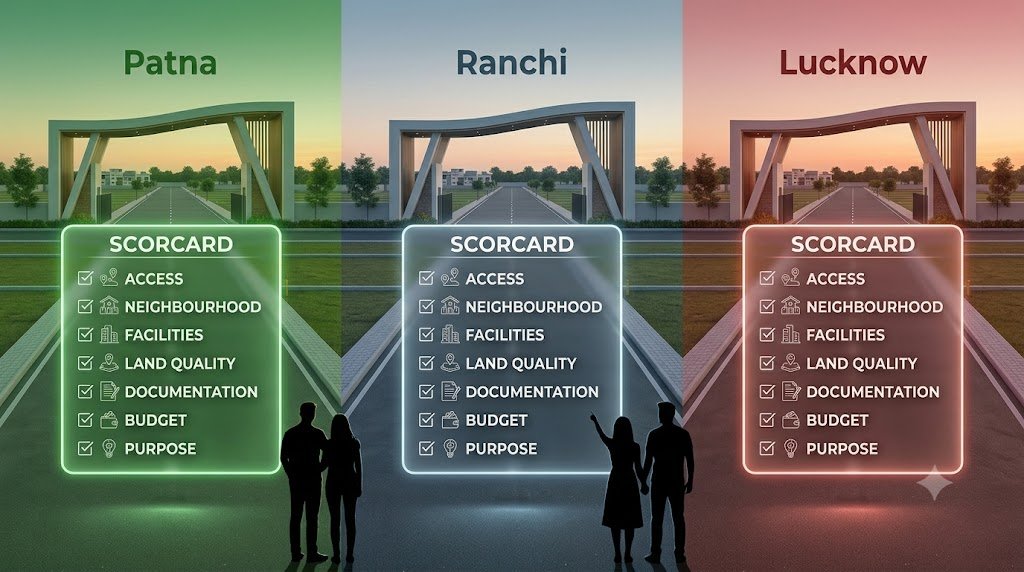
A first time buyer usually starts with a simple question: where should I buy?
If shortlist is Patna, Ranchi and Lucknow, it’s tempting to compare average pricing and pick whichever city gives the most land for the money.
That’s a decent starting point. It isn’t a decision.
Land doesn’t behave like a standard financial product. A plot is tied to one place. You can’t move it if the neighbourhood turns out to be inconvenient, and you can’t separate it from the road, infrastructure and people around it.
First, decide what “better” means to you
For one buyer, the best property is where the family can build a home. For another, it’s a long term asset. Someone else may want a plot that could eventually support rental or commercial use, subject to the right permissions.
So before you compare cities, write down your actual goal. Other wise you end up comparing three markets without knowing what you want from any of them.
Patna: look past the city label
If you are researching land Patna offers, the biggest mistake is treating the whole region as one uniform market.
Central locations, established suburbs and developing corridors can differ a lot in pricing and buyer profile. Comparing specific locations is often more useful than comparing city against city.
A developing part of Patna can suit a buyer who’s happy to wait for the neighbourhood to mature. Someone who needs a fully established setting may be better off in a different part of the city.
Ranchi: local context matters
Ranchi offers a different urban setting and a different mix of established and developing neighbourhoods.
If you’re considering land there, compare the individual property on access, surrounding development, plot usability and documentation. A lower headline price doesn’t automatically mean better value.
That holds in any city. Compare properties that serve similar purposes, not just ones of similar size.
Lucknow: a bigger market still needs due diligence
Lucknow is a large, established urban market, so buyers have plenty of choice. More choice can make shortlisting harder, not easier.
You still need to ask the same things. Where exactly is the plot? What’s around it? How easy is it to reach? What can be built there? Is the paperwork clear?
The city changes. The questions don’t.
A simple scorecard works surprisingly well
If you are genuinely comparing three cities, make a small score card rather than trusting instinct.
- Access: How easy is the property to reach?
- Neighbourhood: Is there existing residential activity?
- Facilities: How far are everyday services?
- Land quality: Are the plot’s shape and size practical?
- Documentation: Can ownership and records be verified?
- Budget: What’s the complete purchase cost?
- Purpose: Does it suit your intend to use?
assign each property score. You may find the city you liked at first isn’t the strongest once the details are on paper.
Where does Bihar fit in?
If you already live in Bihar or have a family ties to the state, investing in Bihar comes with practical advantage: familiarity.
You potentially already know the roads, neighbourhoods and local pattern’s, which makes research easier. But familiarity shouldn’t be an excuse to skip verification.
If Patna is on your shortlist, Dhruv Iconic’s existing guide to buying a plot in Patna works as a separate checklist while you compare locations.
Comparing projects is different from comparing cities
At some point, comparing cities stops being useful.
Once you have narrowed things down to two or three specific projects, compare those directly. Look at location, layout, infrastructure, approval’s, plot sizes and the terms offered to buyers.
Dhruv Iconic’s current projects include plotted developments in Maner and Naubatpur, so you can judge each project on its own instead of going by a city name.
The cheapest city isn’t necessarily the answer
“More for less” can mislead when you’re buying land.
A bigger plot that’s hard to reach may be less useful than a smaller, better connect one. A cheaper property with unclear documents isn’t cheaper if it causes trouble later. And a city that looks great on paper might not suit your family, your work or your plans.
So Patna versus Ranchi versus Lucknow doesn’t really have one winner.
The better question is which specific property give you the strongest mix of location, access, usability, documentation and pricing for the reason you’re buying. Ask that, and the comparison stops being about guessing the future and becomes a sensible decision about today.