
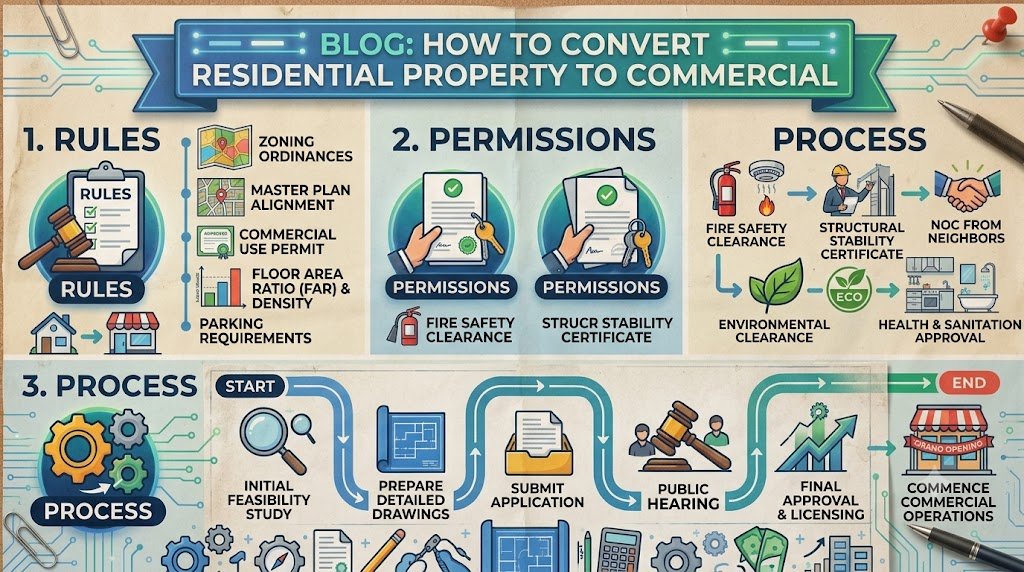
Converting a residential property into a commercial space can be an attractive option for property owners who want to open a shop, office, clinic, consultancy or other business. A house located near a busy road or an established market may appear suitable for commercial activity, but location alone does not determine whether the conversion is legally permitted.
Before changing how a property is used, owners need to understand the applicable land-use rules, building regulations, municipal permissions and any restrictions attached to the property.
If you are wondering how to convert residential property to commercial use in India, this guide explains the key steps, documents, potential costs and common mistakes to avoid, with specific considerations for property owners in Patna and Bihar.
What Does Converting Residential Property to Commercial Use Mean?
A residential property is generally intended for living purposes, while a commercial property is used for activities such as retail, offices, restaurants and certain professional services.
Converting a residential property to commercial use means changing the permitted or approved use of the land or building, or a part of it, from residential to a commercial or another non-residential purpose.
Examples include:
- Converting a house into a retail shop.
- Using a residential building as a corporate office.
- Opening a clinic or consultancy in a residential property.
- Converting a house into a restaurant or café.
- Using part of a residential building for a business.
- Redeveloping a residential property into a commercial establishment.
The permission required depends on the proposed activity, the property’s location, the applicable planning rules and the building’s existing approvals.
Important: Using a residential property for a business is not automatically permitted in every area. Some professional activities or limited commercial uses may be allowed under specific conditions, while other uses may require formal approval or may not be permitted at all.
Can a Residential Property Be Converted into a Commercial Property?
Yes, conversion may be possible, but it depends on the land-use classification, local planning regulations and the nature of the proposed business.
For example, a property on a designated commercial road may have different permitted uses from a house located inside a residential colony. Similarly, running a small professional office may be treated differently from operating a restaurant, warehouse or manufacturing unit.
Before making changes, check three important things:
- Land-use permission: Does the applicable master plan or zoning regulation permit the proposed commercial activity?
- Building approval: Is the building approved for the intended use, and will any alterations require additional permission?
- Business-specific requirements: Does the proposed business require separate licences, registrations or safety approvals?
These checks help establish whether conversion is possible and what process must be followed.
Step-by-Step Process to Convert Residential Property to Commercial Use
The exact process differs across states and local authorities. The following steps provide a general framework for property owners.
Step 1: Check the Existing Land-Use Classification
Start by checking whether the land is classified as residential, commercial, mixed-use or another category under the applicable master plan or development regulations.
The fact that nearby properties operate shops or offices does not automatically mean that your property has the same permissions.
If the property’s current land use does not permit your intended activity, you may need to apply for a change of land use, where such a change is legally available.
Step 2: Contact the Relevant Planning or Municipal Authority
Identify the authority responsible for the property. Depending on the location, this could be a municipal corporation, municipality, development authority or another competent planning body.
Ask about:
- Whether the proposed commercial use is permitted.
- Whether a land-use conversion application is required.
- Whether building-plan revision or a change in occupancy is necessary.
- Which documents must be submitted.
- Applicable fees and inspection requirements.
Getting this clarification before spending money on renovation or equipment can prevent costly mistakes.
Step 3: Check Building Regulations and Existing Approvals
Even when the proposed activity is allowed in principle, the building may need to meet specific requirements.
Depending on the property and intended use, these may relate to parking, access, ventilation, structural safety, fire protection, sanitation, accessibility and permitted construction.
If you plan to modify the building, extend a floor, change the layout or alter its approved use, additional building permission may be required.
Step 4: Prepare the Required Documents
The authority will specify which documents are needed for your application. Depending on the case, these may include:
- Registered sale deed or other ownership documents.
- Current land-use or property details.
- Approved building plan and existing permission records.
- Property tax receipts, where applicable.
- Site plan and building drawings.
- Identity and address documents.
- No-objection certificates, where required.
- Structural, fire-safety or other technical documents, depending on the proposed activity.
Do not assume that every document on a general checklist is mandatory for every property. Confirm the applicable list with the relevant authority.
Step 5: Submit the Application
Submit the required application through the designated online portal or the relevant municipal or planning office.
Some authorities provide separate processes for land-use changes, building-plan approval, revisions to existing plans and occupancy-related permissions.
Pay the prescribed fees and keep the acknowledgement or application number so that you can track progress.
Step 6: Respond to Inspection or Clarification Requests
The authority may examine the documents, review the proposed use or request an inspection.
If additional information or corrections are requested, provide them through the prescribed process. Approval should not be assumed merely because an application has been submitted or a fee has been paid.
Step 7: Obtain Written Approval Before Starting Commercial Operations
Once the applicable permissions have been granted, check the approved conditions carefully.
You may need additional business licences, registrations or safety clearances before opening. Keep copies of the permissions, approved plans and other relevant records.
Avoid beginning a prohibited commercial activity while an application is pending.
How to Convert Residential Property to Commercial Use in Patna, Bihar
Property owners in Patna should check the rules applicable to their exact location and proposed activity. The Bihar Building Bye-Laws, relevant master-plan provisions and requirements of the competent local authority can affect whether a residential property may be used commercially.
Patna Municipal Corporation provides an online building-plan approval service through its AutoMAP portal.
Official portal: https://automap.bihar.gov.in/PATNABPASPORTAL/
The portal provides information on building permits, revisions to approved plans, additions or alterations and occupancy-related applications for the categories it covers.
What should property owners in Patna do?
1. Confirm the jurisdiction
Check whether the property falls within Patna Municipal Corporation or another planning or local authority’s jurisdiction. The responsible authority may differ depending on the property’s exact location.
2. Verify the permitted land use
Check the applicable master plan, zoning classification and relevant building regulations to determine whether the intended commercial activity is allowed.
3. Ask whether a land-use change is needed
A building-plan application is not necessarily the same as permission to change the underlying land-use classification. Confirm which approvals apply to your case.
4. Check building-plan requirements
If the proposed conversion involves alterations or a change in approved occupancy, ask the authority whether a revised plan or other permission is required.
5. Submit the correct application
Patna’s AutoMAP citizen portal provides guidance on selecting the appropriate building approval application and submitting supporting documents. Use the portal’s instructions and seek clarification from the relevant planning section if the required permission is unclear.
For properties outside Patna’s jurisdiction, consult the relevant municipal or planning authority instead of assuming the PMC process applies.
Is Land-Use Conversion the Same as Building-Plan Approval?
No. These are related but distinct matters.
Land-use conversion concerns whether the land may legally be used for a different purpose under the applicable planning framework.
Building-plan approval concerns whether the proposed building design, construction or alterations comply with the relevant building regulations.
A property owner may need one or both, depending on the location, existing approvals and proposed commercial activity.
For example, a building may physically accommodate a shop, but that does not establish that the land is legally permitted for retail use. Similarly, permission for a change in land use does not automatically approve every proposed structural alteration.
Always confirm the full set of permissions applicable to the property.
What Are the Costs of Converting Residential Property to Commercial Use?
There is no single conversion fee that applies to every property across India. The total cost depends on the location, the proposed activity, the property’s existing approvals and the permissions required.
Potential expenses include:
- Land-use conversion charges, where applicable.
- Application and scrutiny fees.
- Building-plan revision or approval fees.
- Architect, engineer or other professional fees.
- Structural modifications and safety upgrades.
- Fire-safety or other required compliance measures.
- Additional business licences or registrations.
- Changes to applicable taxes, utilities or other charges.
In Patna, the official AutoMAP portal publishes fee information for building approval applications. Those fees should not be confused with a separate land-use conversion charge or treated as a universal estimate for every conversion.
Before proceeding, request a clear breakdown of the applicable charges from the relevant authority and obtain estimates for any construction or compliance work.
What Happens If You Use Residential Property for Commercial Purposes Without Permission?
Using a property contrary to its approved use can lead to legal and administrative complications.
Depending on the applicable law and circumstances, consequences may include notices, penalties, restrictions on the activity or directions to restore compliance.
A commercial activity may also face difficulties obtaining the licences, safety approvals or other permissions it requires.
Before opening a business, check the permitted use and obtain the necessary written approvals. If a commercial activity is already operating from a residential property, contact the relevant authority or a qualified property-law professional to understand the correct compliance process.
Important Things to Check Before Converting Your Property
Before committing money to the conversion, review the following checklist.
Verify the property’s legal status
Check the ownership documents, title details and any restrictions that may affect the property’s use.
Review the approved building plan
Confirm the authorised use of the building and whether the existing plan permits the intended activity.
Assess parking and access
Some commercial activities attract more visitors, deliveries or vehicles than ordinary residential use. Check whether the property can meet the applicable access and parking requirements.
Consider neighbours and surrounding uses
Noise, waste, traffic and operating hours may affect nearby residents. The local authority may consider these factors when assessing whether a particular activity is appropriate.
Check business-specific requirements
A clinic, restaurant, coaching centre, office and warehouse can have very different compliance requirements. Identify the relevant licences and safety conditions before investing in fit-outs or equipment.
Get professional advice where needed
An architect familiar with local building regulations or a qualified property-law professional can help identify the permissions applicable to a specific property.
Should You Buy a Residential Property with the Intention of Using It Commercially?
Buying a house because you expect to convert it into a shop, office or other commercial establishment requires careful research.
Before purchasing, verify whether the proposed use is permitted under the applicable zoning rules. Do not rely only on the seller’s assurance, the property’s road-facing location or the fact that nearby buildings have commercial tenants.
Also consider the cost of modifications, parking, accessibility, safety compliance and ongoing operational expenses.
If commercial use is central to your investment plan, it may be more practical to compare properties already approved for the intended purpose with residential properties that would require additional permissions.
The right choice depends on legal feasibility, total cost, location and the requirements of your business.
Frequently Asked Questions
1. Can I convert my residential house into a shop?
Possibly, but you must first check whether retail use is permitted at that location and whether municipal, planning or building approvals are required. Do not assume that every residential property can be converted.
2. Do I need permission to open an office in my house?
Requirements depend on the type of office, the property’s location and applicable local rules. Certain limited professional uses may be treated differently from a customer-facing commercial establishment. Confirm the permitted use with the relevant authority.
3. How do I apply for residential-to-commercial conversion in Bihar?
Start by identifying the competent authority and verifying the property’s land-use classification. Ask whether a land-use change, revised building approval or other permission is required, then follow the prescribed application process.
4. Can I convert only part of my residential property?
In some locations, a limited or mixed-use arrangement may be allowed under specified conditions. The permitted area, activity and approval requirements depend on local rules. Obtain confirmation before using part of the building commercially.
5. Is a land-use conversion certificate enough to start a business?
Not necessarily. Other requirements, such as building approval, occupancy-related permissions, fire-safety clearance or business-specific licences, may also apply.
6. Will property tax change after conversion?
The tax treatment may change depending on the applicable municipal assessment rules and the property’s revised use. Confirm the applicable assessment and any required update with the local authority.
7. Can I convert a residential property without changing its structure?
Even if no structural work is planned, changing the use of a building may still require permission. Check the rules for the intended activity rather than assuming that the absence of construction removes the approval requirement.
Conclusion
Converting residential property to commercial use can create opportunities for business owners and property investors, but the process requires more than changing the building’s interiors or putting up a signboard.
The most important steps are to verify the permitted land use, review the existing building approvals, identify the responsible authority and obtain the required written permissions before starting operations.
For property owners in Patna and elsewhere in Bihar, the applicable master plan, building regulations and local authority requirements should guide the process. Checking these requirements early can help avoid unexpected costs and compliance issues later.